 Casino Tycoon: Vegas Empire
House edge strategy for casino tycoon games
Updated 2026-10-23 · IncrediApp
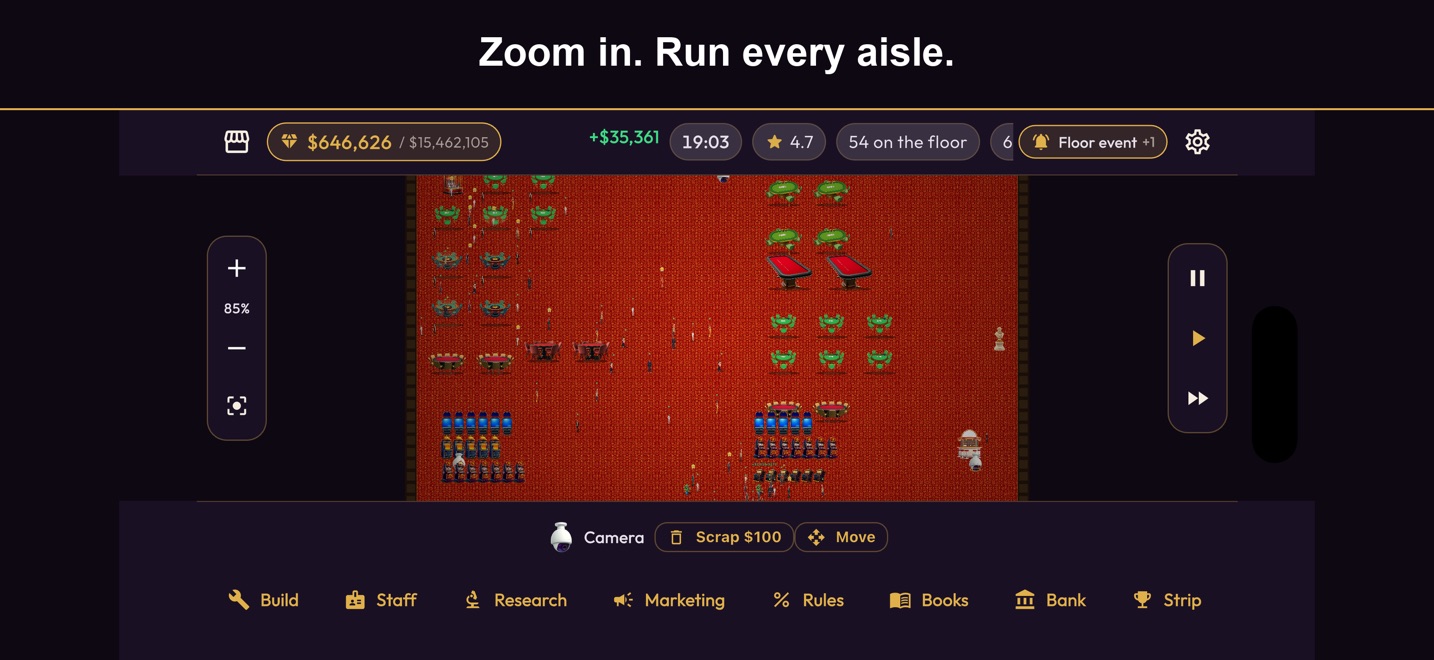
Every casino, real or simulated, runs on one idea: the house edge. It is the small mathematical advantage built into each game, and over thousands of bets it turns into reliable revenue. In a good casino tycoon game, setting that edge is one of your most important decisions. Push it too high and guests leave. Set it too low and you cannot pay the staff. This guide explains how the edge works in real casinos and how to use it in a management sim like Casino Tycoon: Vegas Empire.
This article is about running a virtual casino in a simulation game. It is not gambling advice. Casino Tycoon: Vegas Empire uses virtual money only, with no real-money gambling and no cash prizes.
What the house edge actually is
The house edge is the average percentage of each bet the casino expects to keep over the long run. If a game has a 2% edge, the casino expects to keep about $2 for every $100 wagered. Any single hand or spin can go either way, and players win big sometimes, but across a whole floor and a whole night the results converge toward the edge.
That is why casinos think in terms of volume. Revenue is roughly the amount wagered multiplied by the edge. You can increase it by getting more guests, getting them to play more hands, getting them to bet more per hand, or raising the edge. Only the last one makes guests' experience worse, which is why it needs care.
Real-world house edges by game
Real casinos do not pick an edge from a slider. The edge comes from the rules and the payouts. Changing one rule, such as how much a blackjack pays, changes the edge. Here are well-known figures for common games.
| Game and rule | Typical house edge | What changes it |
|---|---|---|
| Blackjack, 3:2 payout, good rules, basic strategy | About 0.5% | Number of decks, dealer hits or stands on soft 17, doubling and splitting rules |
| Blackjack, 6:5 payout | About 1.4 percentage points higher than the same game at 3:2 | The smaller blackjack payout |
| Roulette, European single zero | 2.70% | One green pocket |
| Roulette, American double zero | 5.26% | Two green pockets |
| Baccarat, banker bet | 1.06% | 5% commission on banker wins |
| Baccarat, player bet | 1.24% | No commission |
| Craps, pass line | 1.41% | Proposition bets are far higher |
| Craps, don't pass | 1.36% | Same as above |
| Jacks or Better, 9/6 full pay, perfect play | About 0.46% | Full house and flush payouts (9/5, 8/5 and so on) |
| Slots | Varies widely | The paytable set by the operator, usually not visible to players |
Two lessons stand out. First, small rule changes have big effects: moving from 3:2 to 6:5 blackjack multiplies the edge on a good game several times over. Second, slots are where operators have the most freedom, because players cannot see the paytable. That freedom is exactly what you get to play with in a tycoon game.
How tycoon games model the edge
Casino tycoon games handle odds in different ways. Some idle games do not model them at all and simply give each machine a fixed income that you upgrade. Others offer a general "price" or "odds" setting. In Casino Tycoon: Vegas Empire, each game family runs a house-rules package, so the edge is implied by the rules rather than being a free dial. For example:
- Slots come in loose, standard, tight and very tight paytables.
- Blackjack offers single-deck 3:2, six-deck 3:2 and six-deck 6:5 tables.
- Roulette is European or American.
- Video poker has better and worse paytables.
- Baccarat, Let It Ride, poker, craps and the sportsbook each have their own rule options, from generous to stingy.
The simulation then applies the edge to every hand played. More hands, bigger bets and a higher edge all mean more take for the house, which is you.
The catch: guests feel the edge
If raising the edge had no downside, every tycoon game would be trivial. In Casino Tycoon, guests feel it. Each session at a game nudges a guest's mood up or down depending on how tight that game is. Low edges leave guests happier, high edges sour them, and very tight slot holds make tourists noticeably unhappier. Unhappy guests leave sooner, and the overall mood of your floor feeds into your star rating, which controls which games you unlock and how attractive your casino is.
So the edge is a trade-off between revenue per hand now and traffic later. That is also how real casinos think about it, which is why some advertise loose slots or 3:2 blackjack as a selling point.
When to tighten and when to loosen
The game's own advice is simple: tighten when the room is full, loosen when tourists bounce. Here is how to apply it.
Tighten when demand is high
If every seat is taken and guests are waiting, you are leaving money on the table. Extra guests cannot play anyway, so a slightly tighter edge earns more from the guests who are seated without costing you much traffic. Celebrity visits and successful marketing campaigns are good moments to tighten.
Loosen when the room empties
If machines sit empty and mood bubbles turn sour, a looser edge is one of the fastest fixes, together with cleaning up and adding a bar or restroom. A full floor at a modest edge usually beats an empty floor at a predatory one.
Price by guest type
Casino Tycoon has three kinds of guests. Tourists have small bankrolls and little patience for tight games. Grinders play long sessions with mid-sized bankrolls. Whales arrive with deep pockets. The game includes one-tap tourist, grinder and whale presets that set a game's bet limits and nudge its rules to match. A floor aimed at tourists should stay fairly loose, while high-limit cabinets and tables for whales can carry more.
Lean on low-edge table games for stars
Tables like blackjack and baccarat earn from volume and bigger bets rather than a high edge. Keeping them on generous rules is a cheap way to keep guests happy while the slots carry more of the margin.
Other ways to raise revenue without raising the edge
- More hands per hour. Research and specialist staff like pit bosses and slot attendants speed up play.
- Bigger bets. High-limit cabinets and the whale stakes research let big spenders bet more.
- More guests. Marketing campaigns, a clean floor and good ambience bring in traffic.
- Lower costs. Check the Books after each night. Wages are often where profit disappears.
A note on real gambling
Everything above is why casinos win in the long run. Running the numbers from the operator's side is a good reminder that every real casino game is designed with an edge against the player. In Casino Tycoon you get to enjoy that math from the safe side of the table, with virtual money only. If you want to go deeper on real game odds as a learning exercise, our sister app's blog covers how blackjack rules change the house edge.
New to the genre? Start with what a casino tycoon game is, then read our floor plan tips.
FAQ
- What is the house edge?
- The average share of each bet that the casino keeps over the long run. A 2% edge means that, on average, the house keeps $2 of every $100 wagered, although individual results swing a lot.
- Which casino games have the lowest house edge?
- In real casinos, blackjack with good rules and correct strategy, the banker bet in baccarat, the pass and don't pass bets in craps, and full-pay video poker played well have some of the lowest edges, typically around 0.5% to 1.5%.
- Should I set tight odds in a casino tycoon game?
- Only when demand can carry it. Tight odds earn more per hand, but unhappy guests leave sooner and come back less. Tighten when the floor is full and loosen when guests are bouncing.
- Is this advice for real gambling?
- No. This article explains the math casinos use so you can run a virtual casino in a simulation game. In real gambling the house edge means the casino is expected to win over time.