 BANNERS FOR HIRE
Fantasy hex wargame: what it is and how it plays
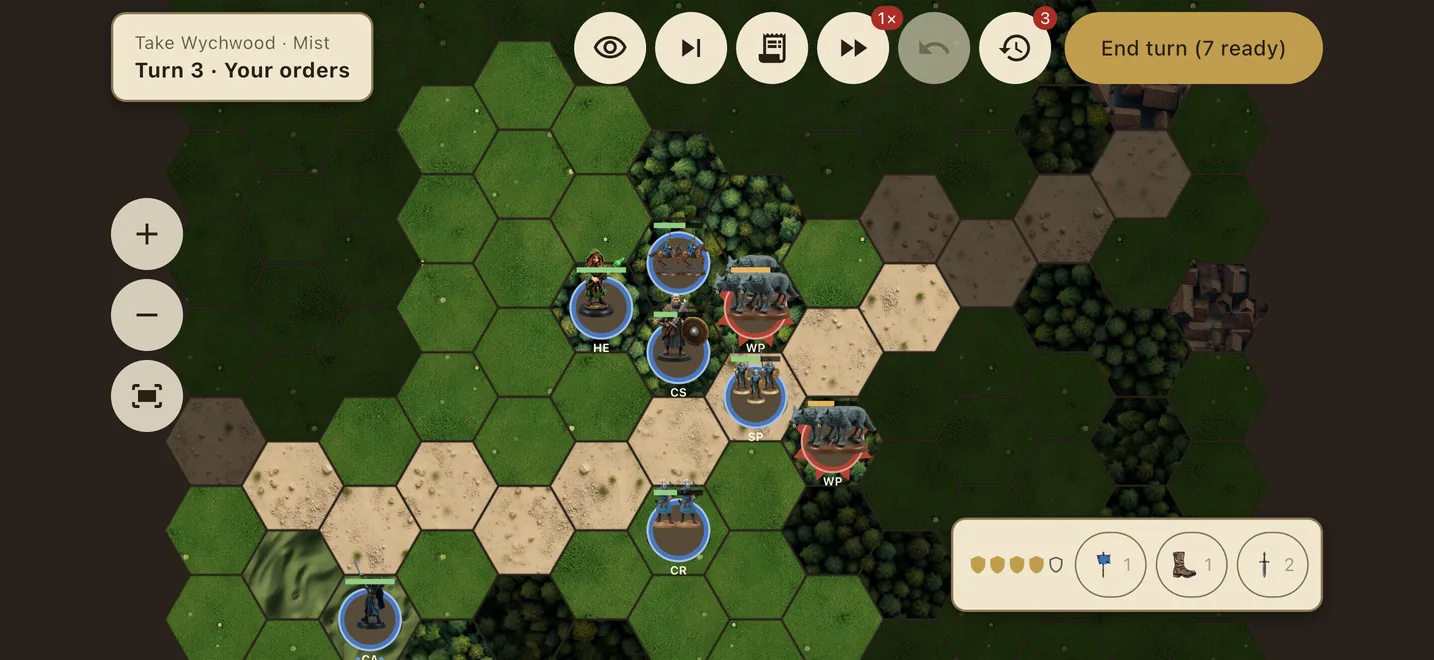
A fantasy hex wargame is a turn-based strategy game where armies of knights, archers, monsters and mages fight across a map made of hexagons. You move a unit, read the ground, check the odds and commit. Then the enemy does the same. It is a slow, thoughtful genre, and it has a loyal audience that has been chasing the feeling of the great 90s fantasy wargames ever since.
This guide explains what the genre is, where it came from, how it differs from tactics RPGs and 4X games, and what to look for in a modern one, especially on a phone or tablet. We make Banners for Hire, a fantasy hex wargame, so we use it for examples, and we say so clearly.
The short definition
Strip the genre down and you get four ingredients:
- A hex map. The battlefield is divided into hexagons, and every hex has a terrain type: open field, forest, hills, river, town.
- Turns. You give orders to your army, then the enemy gives orders to theirs. Nothing happens in real time.
- Units, not characters. Each counter on the map is usually a regiment or a band, not a single hero. A unit of spearmen has strength, experience and morale.
- An army that persists. In the best games, the units that survive a battle carry into the next one, stronger and more valuable, so every loss hurts.
Add dragons, undead and a campaign map, and you have a fantasy hex wargame.
Where the genre comes from
Hex maps come from tabletop wargaming, where they were used for decades because they make movement and distance fair in every direction. When computer wargames arrived, many kept the hexes. The fantasy branch grew up in the 1990s. The best-remembered example is Fantasy General, published by SSI in 1996, which took the structure of Panzer General and swapped tanks for knights, wizards and monsters. Players loved that it was easy to read but hard to master, and that a veteran unit you had kept alive for ten battles felt like an old friend.
That game has a modern sequel on PC and consoles, and its DNA shows up in a long list of later games. When people search for a "Fantasy General clone" or a "Fantasy General–style game", they usually mean this whole tradition: hex battles, a campaign of linked scenarios and a core army that grows with you. We go through the current options in games like Fantasy General on mobile.
Why hexes matter
On a square grid, a diagonal step covers more ground than a straight one, and "adjacent" can mean four or eight squares depending on the rules. Hexes avoid both problems. Every neighbour is the same distance away, so a unit's reach looks the same in every direction. That makes the classic wargame ideas easy to read at a glance:
- Zones of control. A unit "pins" the hexes around it, so enemies cannot just walk past. A thin line of units can hold a wide front.
- Flanking. Attacking from more than one side is clearly visible and usually rewarded.
- Terrain. One hex of forest or a river crossing can decide a battle, because everyone can see exactly where the choke point is.
We dig into these mechanics in the hex tactics guide.
Hex wargame vs tactics RPG vs 4X
The genre borders on two others, and the lines get blurry, so it helps to compare them.
| Fantasy hex wargame | Tactics RPG | 4X strategy | |
|---|---|---|---|
| What you control | An army of units or regiments | A small party of heroes | An empire |
| Main decision | Where to fight and with what | Which skill to use this turn | What to build and research |
| What persists | Your veteran army | Character levels and gear | Cities and territory |
| Typical session | One battle | One encounter | Many turns of a long game |
Many modern games mix these. Banners for Hire, for example, is a hex wargame at heart, but it adds the company management of modern mercenary games: named units with ranks and traits, wages to pay and a camp to build between battles. That is a deliberate blend, and it is why we describe it as being in the tradition of the classic fantasy wargames rather than a copy of any one of them.
What makes a good one
These are the things we would look for in any fantasy hex wargame:
- Readable odds. You should know roughly what an attack will do before you make it. Hidden dice that make careful plans pointless are the fastest way to lose a wargame player. Banners for Hire shows an honest forecast before every attack.
- Terrain that matters. Forests, hills, rivers and towns should change how you fight, not just how the map looks.
- A fair AI. An enemy that cheats with perfect information feels bad to beat and worse to lose to. In Banners for Hire the enemy plays by the same rules and sees only what its soldiers see.
- Consequences. Losing a veteran unit should hurt. Keeping one alive for a whole campaign should feel like an achievement.
- Room to experiment. Undo, skirmish modes and editors let you learn without being punished, while an Ironman option keeps things tense for veterans. More in Ironman mode vs undo.
Fantasy hex wargames on mobile
The genre suits a touchscreen surprisingly well. Turns give you as long as you need, so there is no fighting the controls, and a battle fits a commute or a coffee break. The challenges are screen size and interface: a map of tiny hexes that you cannot tap accurately is no fun. Look for games designed for touch from the start, playable in landscape, with clear unit information, zoom and good accessibility options. For a broader list across styles, see the best fantasy turn-based strategy games for Android.
Pricing is worth checking too. Many strategy games on mobile run on energy timers or paid currencies, which do not mix well with a genre about patience. We built Banners for Hire so that Act 1, skirmishes, daily and weekly contracts and the scenario editor are free, one purchase unlocks Acts 2 and 3, rewarded ads are optional buttons you can hide, and there are no energy systems or paid currencies. It also plays offline.
Where Banners for Hire fits
In Banners for Hire you inherit a mercenary company after its captain dies: five banners, a cart with one good wheel and a debt. Battles are turn-based on hexes with terrain, line of sight, zones of control, flanking, charges, support fire and morale, plus fog of war and weather. Between battles you run the company: recruit, pay wages, promote soldiers toward Legend rank, build up the camp and choose which of three patrons to work for. A voiced three-act story leads to six endings, one of them secret. Read more about that side of the game in how to run a mercenary company.
It is not a remake of any 90s game, and it is not affiliated with one. It is our take on the same genre, built for phones and tablets.
Getting started
If you are new to the genre, start on an easier difficulty, use undo freely and pay attention to terrain before anything else. If you are coming back to it after years away, the core habits still hold: keep a line, never leave a unit alone, and protect your veterans. Then read how hex tactics work for the details.
FAQ
What is a fantasy hex wargame?
A turn-based strategy game where armies of fantasy units fight on a map divided into hexagons. Terrain, positioning, facing the right enemy with the right unit and keeping your army alive between battles matter more than reflexes or luck.
Why do wargames use hexes instead of squares?
Every hex has six neighbours at the same distance, so movement and range work the same in every direction. That makes flanking, surrounding a unit and holding a line cleaner to read than on a square grid with diagonals.
Is a hex wargame the same as a 4X game?
No. A 4X game is about building an empire: cities, economy, research and expansion. A hex wargame is about the battle itself and the army you carry from one fight to the next. Some games blend the two.
Are there fantasy hex wargames on iPhone and Android?
Yes. Banners for Hire is a turn-based fantasy hex wargame for Android, with the iPhone and iPad version coming to the App Store. Our roundup of games like Fantasy General covers other options on mobile.