 BANNERS FOR HIRE
Mercenary company game: how to run your own band of hired swords
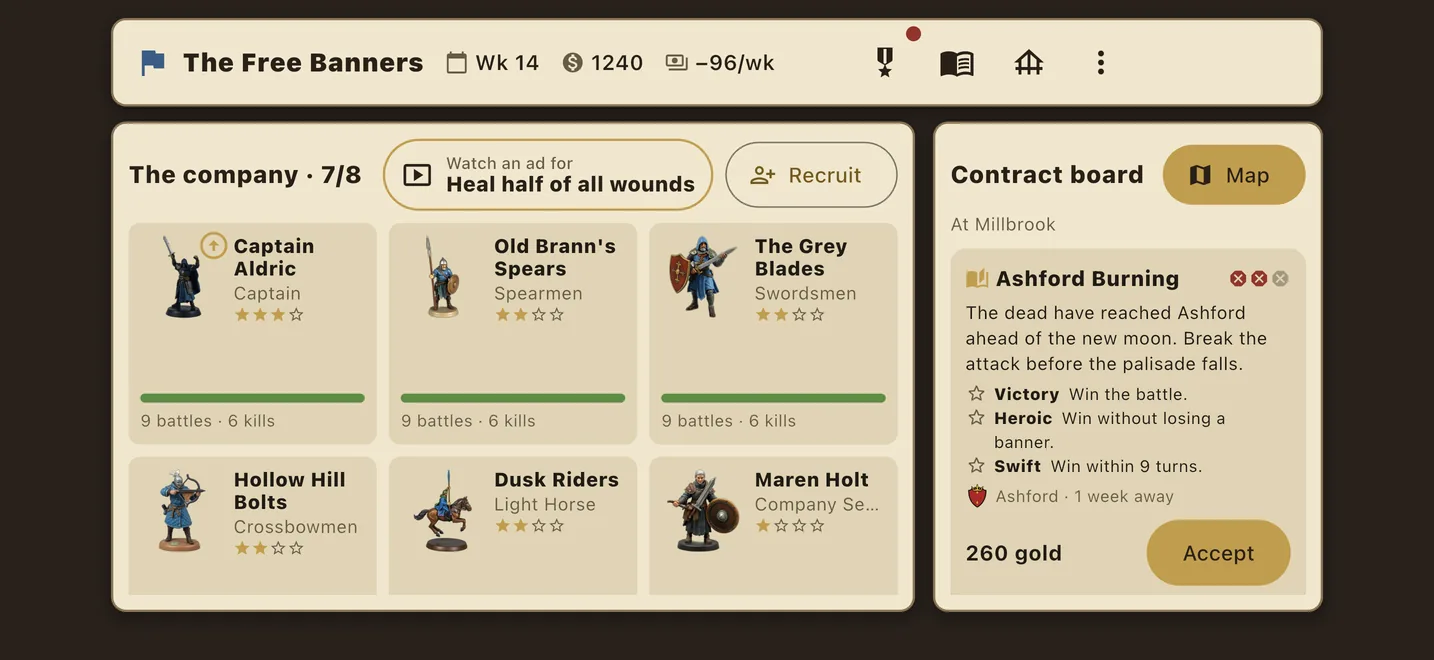
Some strategy games hand you an army. A mercenary company game hands you a payroll. You do not fight for a flag; you fight for the next contract, the next wage day and the people who have followed you this far. That mix of hard tactics and soft attachment is what makes the genre so sticky, and it is why we built Banners for Hire around a company of hired swords.
This guide covers what makes a good mercenary company game and how to run one well, with specific examples from Banners for Hire.
What makes a mercenary company game different
In a classic fantasy hex wargame, you command an army and the campaign tells you where to fight. In a mercenary company game, more of those decisions are yours, and so are the costs:
- Money is tight. Soldiers expect to be paid, and gear and recruits cost gold.
- People matter. Units have names, histories and quirks, so losing one stings.
- Loyalties shift. You choose employers, and the ones you work against remember it.
- The campaign is a road. Every march costs time, and you choose where to go next.
Banners for Hire combines hex battles in the tradition of the 90s fantasy wargames with this kind of company management. For the battle side, see the hex tactics guide.
Inheriting the company
Banners for Hire opens with a funeral. Captain Hesk is three days in the ground, and his company passes to you: five banners, a cart with one good wheel and a debt nobody will say aloud. That start sets the tone. You are not a chosen hero; you are a new captain trying to keep a struggling outfit alive in a realm at war, where the dead are walking again.
1. Every banner has a name
Your soldiers in Banners for Hire are not interchangeable. Each banner has a name, gains ranks up to Legend, earns traits and carries scars from the battles it survives. Over a campaign, that turns units into characters you recognise and worry about.
The practical lesson is simple: protect your veterans. A unit with high rank and good traits is worth far more than a fresh recruit, and replacing it costs time and gold. Rotate battered units out of the front line and reinforce the wounded between fights. When soldiers do fall, their names go on the memorial wall.
2. Wages, recruits and reinforcements
A company that cannot pay its soldiers will not stay a company for long. In Banners for Hire you pay wages, recruit new troops and reinforce the wounded, so every contract is a balance between what it pays and what it will cost you in men and gear.
- Don't over-recruit early. A bigger roster means a bigger wage bill.
- Reinforce before you replace. Topping up an experienced unit usually beats hiring a new one.
- Pick contracts you can win cleanly. A pyrrhic victory can cost more than the fee.
3. The captain, lieutenants and specialists
You lead from the front. Your captain has a skill tree, so you shape what kind of commander you are. Two lieutenants travel with the company, each with their own story, and rare specialists sign on for a season. Choosing which of these to invest in, and which to keep safe in battle, is a big part of how your company plays.
4. Grow the camp
Between battles, the camp is your base. In Banners for Hire you build a forge, barracks and chapel, research new troops and Captain's orders, and reforge gear into masterwork. There are over forty items and relic sets to find, buy in town markets, salvage or upgrade at the forge. Investing in the camp is how a ragged outfit becomes a company that people fear.
5. Choose your patron carefully
Three powers want your banner: the Crown, the Thornwood and the Ironhold Compact. Banners for Hire has a hand-written, fully voiced story across three acts, and each patron has its own path. Your choices change who rules each region and who sends hunters after you. There are six endings in total, one of them secret.
Across fifteen regions and four powers, reputation matters. Work for a power to win its favour; fight against it and it will remember. Every road is a week's march, so where you go next is as important as how you fight when you get there. Caves, towers and shrines along the way can hide treasure, recruits or something worse.
6. Contracts beyond the campaign
A mercenary company always needs work, and Banners for Hire has plenty of it beyond the story:
- Daily and weekly contracts: the same battle for everyone, every day and every week. Chase your best score and keep the streak.
- Skirmish and scenario editor: pick the foe, the ground and the odds, or paint your own map and share it with a code.
- Company runs: ten contracts, one life.
- Notoriety and New Game+: ten tiers of Notoriety and New Game+ for veterans of every ending.
More on these modes in skirmish, editor and contracts.
7. Ironman or not?
Mercenary games are at their most tense when losses are permanent. Banners for Hire lets you choose: undo moves and rewind a turn while you learn, or play Ironman with every order standing. Many players start with undo and switch to Ironman for a second campaign or a company run. See Ironman mode vs undo.
Is it free?
Act 1 of the campaign, skirmishes, the daily and weekly contracts and the scenario editor are free. One optional purchase unlocks Acts 2 and 3 for good. Rewarded ads only appear as buttons you choose to press, and you can hide them in Settings. There are no energy timers and no paid currencies, and the campaign plays offline.
Quick tips for new captains
- Protect veterans first; recruits are replaceable, Legends are not.
- Keep the wage bill in line with the contracts you can actually win.
- Use the forge to upgrade and reforge the gear you find.
- Think about which patron you want before you burn bridges with the others.
- Explore caves, towers and shrines, but go in prepared.
New to the genre? Read what a fantasy hex wargame is, or compare options in games like Fantasy General on mobile.
FAQ
What is a mercenary company game?
A strategy game where you run a band of soldiers for hire. You take contracts, fight battles, pay wages, recruit and equip soldiers and decide who to work for. The company itself, and the people in it, are the heart of the game.
What happens when soldiers fall in Banners for Hire?
Their names go on the memorial wall. Losses matter because every banner has a name, ranks, traits and scars. You can undo moves or rewind a turn while you learn, or play Ironman so every order stands.
How many endings does Banners for Hire have?
Six. Each of the three patrons, the Crown, the Thornwood and the Ironhold Compact, has its own path, and one ending is secret.
What can I do after finishing the campaign?
Daily and weekly contracts, skirmishes, the scenario editor with share codes, company runs of ten contracts with one life, ten tiers of Notoriety and New Game+.